

Legal Area
Criminal Law | Arrest Procedure | BNSS Reforms | Constitutional Law
Court
Supreme Court of India
Year
2025
Background
The power of arrest has always been a critical component of criminal procedure in India. While arrest is intended to aid investigation and ensure the presence of the accused, its misuse has repeatedly attracted judicial scrutiny. Recognizing this, constitutional courts have consistently emphasized that arrest should not be used as a punitive tool prior to conviction.
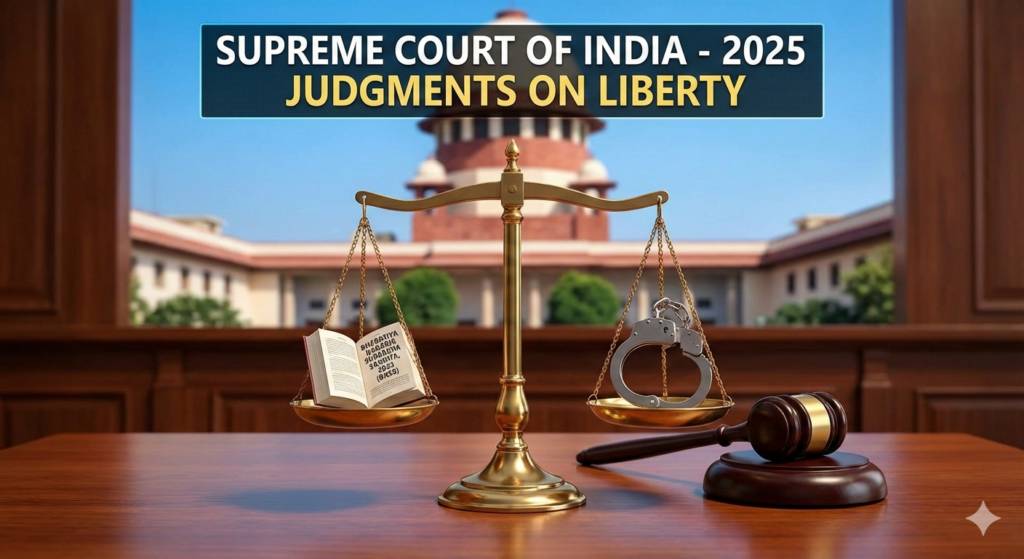
With the introduction of the Bharatiya Nagarika Suraksha Sanhita (BNSS), 2023, which replaced the Criminal Procedure Code, 1973, Parliament sought to modernize criminal procedure while retaining constitutional safeguards. In 2025, the Supreme Court examined how arrest provisions under the BNSS must be interpreted in light of fundamental rights guaranteed under Articles 14 and 21 of the Constitution.
Key Issue Before the Court
The principal issue before the Supreme Court was whether the procedural changes introduced by the BNSS permit a broader exercise of arrest powers, or whether arrests must continue to be governed by the principles of necessity, proportionality, and judicial oversight.
The court was also required to consider whether routine arrests without recorded reasons violate the constitutional right to personal liberty under the new legal framework.
Court’s Observations
The Supreme Court categorically observed that arrest cannot be treated as an automatic consequence of the registration of an offence. The court reiterated that liberty is a fundamental right and any curtailment of it must be justified by compelling reasons.
The bench emphasized that under the BNSS, police officers are duty-bound to record reasons for arrest and demonstrate the necessity of custodial detention. Arrests made without compliance with statutory and constitutional safeguards were held to be legally unsustainable.
The court further clarified that the BNSS does not dilute existing judicial guidelines governing arrest, including the principles laid down in earlier landmark decisions. Instead, the new law must be read in a manner that strengthens accountability and transparency in police action.
Impact on Criminal Justice Administration
This ruling has wide-ranging implications for criminal investigations, particularly in cases involving economic offences, regulatory violations, and disputes with a predominantly civil character. The Supreme Court’s reaffirmation discourages the practice of effecting arrests merely to exert pressure on the accused.
The judgment also provides strong support to individuals seeking anticipatory bail or protection from arrest under the BNSS, reinforcing the idea that arrest must be the exception rather than the norm.
Legal Significance
The decision reinforces continuity in constitutional jurisprudence despite legislative changes in criminal procedure. It serves as an authoritative reminder that procedural reforms cannot override fundamental rights.
By aligning BNSS provisions with established constitutional principles, the Supreme Court has ensured that the transition to the new criminal law regime does not compromise personal liberty.
Why This Matters
The ruling strengthens safeguards against arbitrary arrest
It reinforces judicial oversight under the BNSS framework
It protects individuals from unnecessary pre-trial detention
It guides law enforcement agencies on lawful arrest practices
Conclusion
The Supreme Court’s 2025 ruling on arrest powers under the BNSS reaffirms that personal liberty remains central to India’s criminal justice system. By insisting on restraint, accountability, and constitutional compliance, the court has sent a clear message that procedural modernization must coexist with robust protection of fundamental rights. This judgment is expected to significantly influence arrest-related practices and judicial scrutiny in the post-BNSS era.