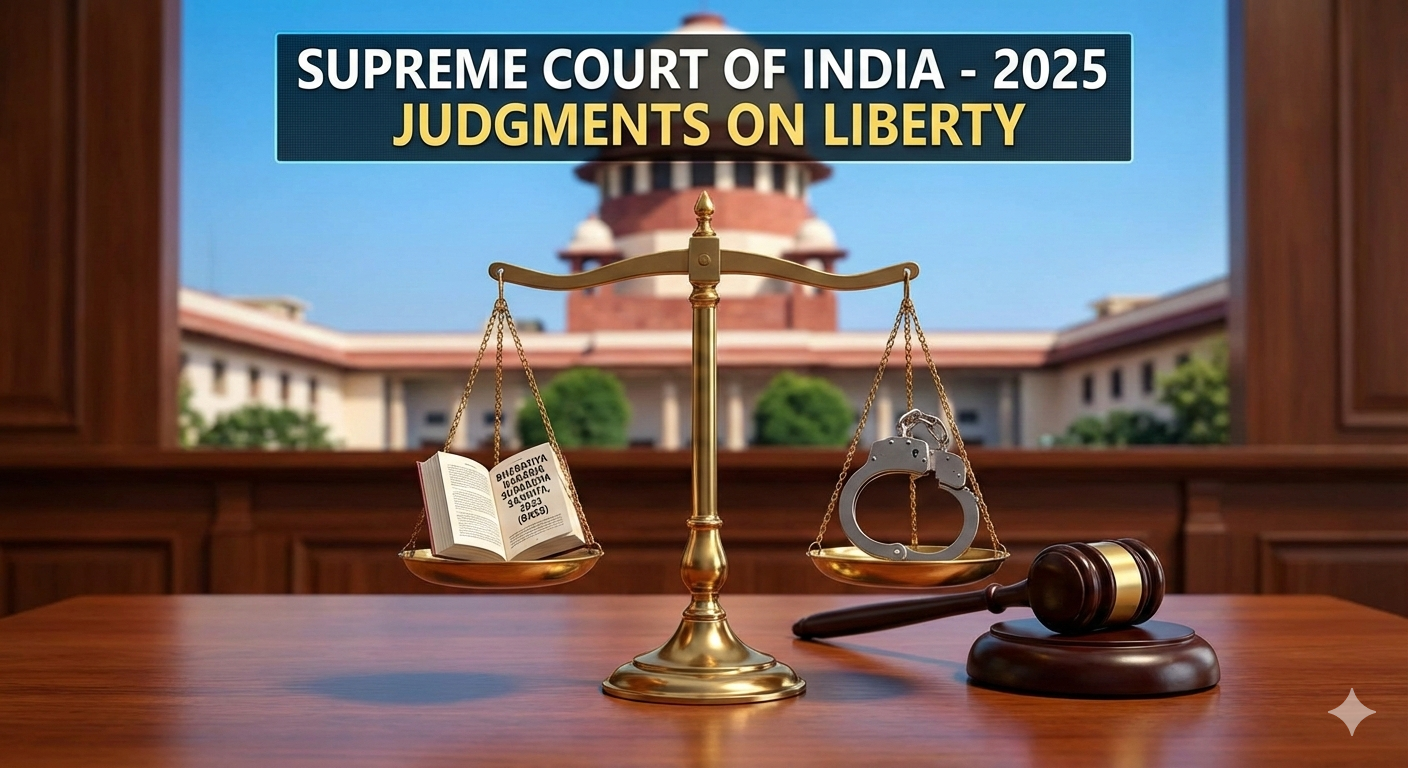


Legal Area
Criminal Law | Undertrial Prisoners | Speedy Trial | Constitutional Rights
Court
Supreme Court of India
Year
2025
Background
The issue of prolonged incarceration of undertrial prisoners has been a recurring concern in India’s criminal justice system. A significant number of accused persons continue to remain in custody for years without their trials reaching conclusion, often for offences carrying comparatively lesser sentences. Courts have repeatedly highlighted that such prolonged detention undermines the constitutional guarantee of personal liberty under Article 21.
In 2025, the Supreme Court revisited this issue while dealing with cases where undertrial prisoners had spent a substantial portion of the maximum possible sentence in custody, even though the trial had made little progress.
Key Issue Before the Court
The key issue before the Supreme Court was whether continued detention of undertrial prisoners, in the absence of timely progress in trial, violates the constitutional right to a speedy trial and personal liberty.
The court was also required to examine the responsibility of trial courts and prosecuting agencies in ensuring that criminal proceedings are conducted within a reasonable timeframe.
Court’s Observations
The Supreme Court observed that the right to a speedy trial is an integral part of the right to life and personal liberty. The court noted that prolonged incarceration without adjudication amounts to punishment before conviction and defeats the presumption of innocence.
The bench emphasized that courts must actively monitor the duration of custody of undertrial prisoners and examine whether continued detention serves any meaningful purpose. Where investigation is complete, evidence is largely documentary, or the accused is not likely to abscond or influence witnesses, denial of bail was held to be unjustified.
The court further observed that systemic delays, including overcrowded courts and administrative inefficiencies, cannot be used as grounds to curtail individual liberty indefinitely.
Impact on Trial Courts and Bail Jurisprudence
This ruling places an affirmative duty on trial courts to periodically review the custody status of undertrial prisoners. Courts were encouraged to adopt a pragmatic approach while considering bail applications, particularly where the accused has already undergone prolonged detention.
The judgment also reinforces the principle that incarceration should not become the default option merely due to delays in the justice delivery system.
Legal Significance
The decision strengthens jurisprudence on undertrial rights and reinforces the constitutional mandate of speedy justice. It aligns with earlier judicial pronouncements that emphasize bail as the rule and jail as an exception, particularly in cases involving excessive pre-trial detention.
The ruling is expected to influence bail decisions and reduce overcrowding in prisons by encouraging courts to reassess prolonged custody cases.
Why This Matters
It protects undertrial prisoners from indefinite incarceration
It reinforces the right to a speedy trial
It promotes judicial accountability in managing criminal trials
It addresses systemic delays affecting criminal justice
Conclusion
The Supreme Court’s 2025 ruling on undertrial detention reaffirms that liberty cannot be sacrificed due to systemic inefficiencies. By emphasizing the right to a speedy trial and judicial vigilance over prolonged custody, the court has reinforced a humane and constitutionally compliant approach to criminal justice. This decision is likely to have a lasting impact on how courts balance societal interests with individual rights.