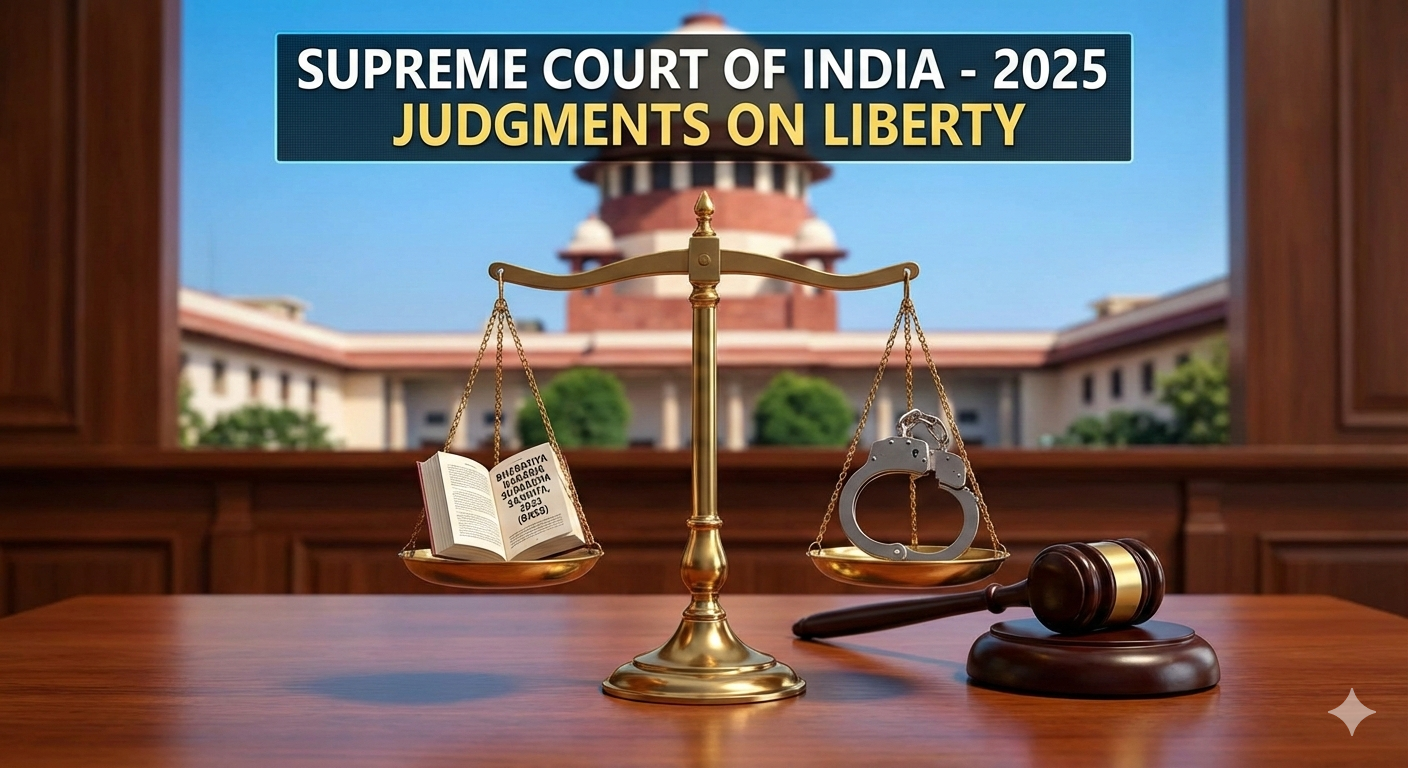


Legal Area
Constitutional Law | Preventive Detention | Personal Liberty | Procedural Safeguards
Court
Supreme Court of India
Year
2025
Background
Preventive detention laws have long occupied a sensitive space within India’s constitutional framework. While such laws permit detention without trial in specific circumstances, they are considered exceptions to the fundamental right to personal liberty guaranteed under Article 21 of the Constitution. Courts have therefore consistently held that preventive detention statutes must be applied strictly and with full adherence to procedural safeguards.
In 2025, the Supreme Court examined multiple challenges to detention orders passed under preventive detention laws, where detenues alleged non-compliance with constitutional and statutory requirements. These cases brought renewed focus on the balance between state security interests and individual liberty.
Key Issue Before the Court
The central issue before the Supreme Court was whether procedural lapses in passing and executing preventive detention orders render such detention illegal. The court was required to assess whether delays in communication of grounds of detention, non-supply of relevant documents, or mechanical approval by authorities violate constitutional safeguards.
Another issue concerned the extent to which courts can review the subjective satisfaction of detaining authorities.
Court’s Observations
The Supreme Court reiterated that preventive detention laws must be interpreted narrowly and applied with extreme caution. The bench emphasized that procedural safeguards are not mere formalities but substantive protections against arbitrary state action.
The court observed that detenues must be informed of the grounds of detention at the earliest opportunity and must be supplied with all relevant materials relied upon by the detaining authority. Any delay or omission that hampers the detenu’s right to make an effective representation was held to vitiate the detention order.
While acknowledging the limited scope of judicial review over subjective satisfaction, the court clarified that procedural compliance remains fully justiciable. Mechanical approval of detention orders or casual handling of statutory timelines was strongly discouraged.
Impact on Detention Practices
The ruling places renewed responsibility on executive authorities to ensure strict compliance with preventive detention laws. Authorities are now required to exercise heightened diligence while issuing detention orders and must maintain detailed records demonstrating adherence to statutory requirements.
The judgment also strengthens the position of detenues seeking judicial review of detention orders on procedural grounds.
Legal Significance
This decision reinforces constitutional jurisprudence that preventive detention, being an exceptional measure, must be accompanied by rigorous procedural safeguards. It affirms the judiciary’s role as a guardian of personal liberty and a check against excessive executive power.
The ruling is expected to influence how High Courts scrutinize detention orders and may lead to greater accountability in preventive detention cases.
Why This Matters
It reinforces constitutional protection of personal liberty
It limits arbitrary use of preventive detention powers
It strengthens the right to effective representation
It promotes accountability in executive decision-making
Conclusion
The Supreme Court’s 2025 reiteration of procedural safeguards in preventive detention cases underscores the enduring importance of constitutional discipline. By insisting on strict compliance with statutory and constitutional requirements, the court has reaffirmed that even in matters of state security, personal liberty cannot be compromised through procedural shortcuts. This judgment is likely to remain a significant reference point in preventive detention jurisprudence.