
Legal Area
Criminal Law | FIR Registration | Abuse of Process | Civil–Criminal Overlap
Court
High Court (Multiple Jurisdictions)
Year
2025
Background
Indian courts have repeatedly expressed concern over the increasing tendency to give a criminal colour to disputes that are essentially civil or commercial in nature. Matters arising out of contracts, business transactions, partnership disagreements, and property arrangements are often converted into criminal complaints by invoking offences such as cheating, criminal breach of trust, and criminal intimidation.
In 2025, several High Courts revisited this issue while dealing with petitions seeking quashing of FIRs registered in disputes where civil remedies were already available or actively pursued. These cases highlighted the burden placed on the criminal justice system due to misuse of penal provisions for recovery, pressure tactics, or personal vendetta.
Key Issue Before the Court
The primary issue before the High Courts was whether the registration and continuation of criminal proceedings in purely civil or commercial disputes amount to abuse of the process of law.
The courts were also called upon to examine the role of the police at the stage of FIR registration and whether preliminary scrutiny is required to prevent mechanical registration of criminal cases.
Court’s Observations
The High Courts observed that the existence of a civil dispute does not automatically bar criminal proceedings; however, criminal law cannot be used as a tool to settle scores or exert pressure in matters essentially governed by civil law.
The courts emphasized that allegations must disclose the essential ingredients of the alleged criminal offences. Mere breach of contract, delay in payment, or failure to fulfil contractual obligations, without dishonest intention at the inception, does not constitute a criminal offence.
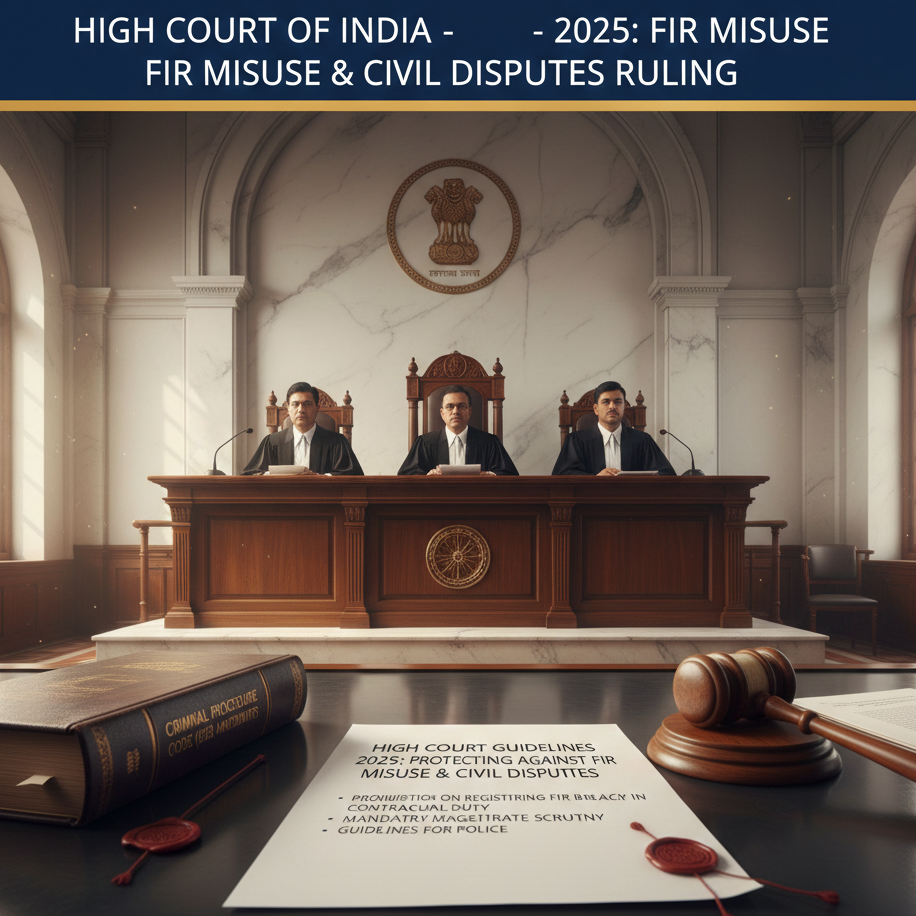
Several benches reiterated that police authorities must apply their mind before registering FIRs in commercial and contractual disputes. Mechanical registration without examining the nature of allegations was held to be contrary to settled legal principles.
Guidelines and Judicial Approach
The High Courts stressed the importance of judicial scrutiny under inherent powers while dealing with petitions for quashing of FIRs. Courts were reminded to examine the complaint as a whole and assess whether continuation of criminal proceedings would serve the ends of justice.
The judgments also reinforced that criminal law should not be permitted to become a parallel forum for enforcing civil claims, particularly when civil suits, arbitration proceedings, or recovery mechanisms are already in progress.
Impact on Criminal Justice System
These rulings are expected to provide relief to individuals and businesses facing criminal proceedings arising out of civil disputes. By discouraging misuse of FIRs, the courts aim to reduce unnecessary criminal litigation and protect individuals from harassment through criminal process.
The decisions also place greater responsibility on investigating agencies to exercise caution and uphold fairness at the threshold stage of criminal proceedings.
Legal Significance
The High Courts’ approach strengthens safeguards against abuse of criminal law and reinforces the distinction between civil wrongs and criminal offences. It aligns with the broader constitutional mandate of fairness, due process, and protection against arbitrary prosecution.
These rulings are likely to influence how trial courts and police authorities handle complaints involving civil–criminal overlap in the future.
Why This Matters
It curbs misuse of criminal law in civil disputes
It protects individuals and businesses from coercive prosecution
It reinforces judicial oversight over FIR registration
It promotes responsible use of criminal justice mechanisms
Conclusion
The 2025 High Court rulings on misuse of FIRs reaffirm that criminal law must be invoked with caution and responsibility. By emphasizing substance over form and intent over allegation, the courts have reinforced that criminal proceedings cannot be permitted to substitute civil remedies. These decisions are expected to play a crucial role in maintaining the integrity of the criminal justice system and preventing its misuse for collateral purposes.